It started as a completely ordinary morning.
I had just opened a package of bacon, planning a quick breakfast before work. Nothing fancy—just a simple meal, the kind of easy recipe millions of Americans make every week. The bacon was from a brand I’d bought dozens of times. The sell-by date was fine. Everything looked normal.
But the moment I separated the bacon slices, something strange caught my eye.
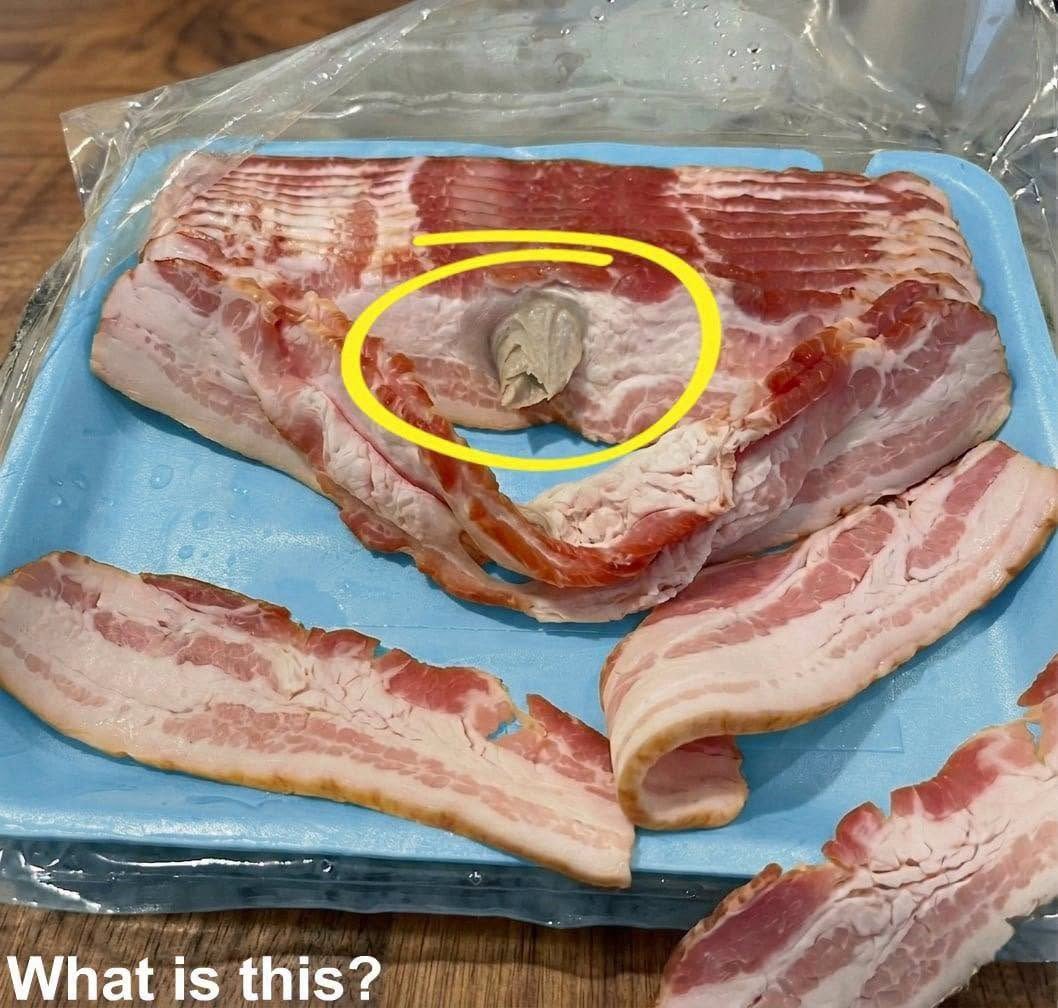
Nestled between the third and fourth strips was a pale, rubbery chunk about the size of my thumb. It wasn’t bacon-colored. It wasn’t the right texture. It looked vaguely like cartilage, vaguely like plastic, and vaguely like something that should absolutely not be touching my breakfast.
My stomach dropped.
At first glance, it didn’t even look like food. My mind immediately jumped to worst-case scenarios. Was it plastic? Some kind of contamination? Had something gone wrong during processing? I stared at it for a full thirty seconds, trying to decide whether to call the USDA, the FDA, or my mother (who somehow knows everything about meat).
If you’ve ever focused on healthy eating, meal prep, or feeding your family nutritious meals, you know how unsettling it can be when something unexpected shows up in your food. You want to feel good about what you’re cooking. You want to trust the food industry. And then a weird bacon chunk shows up and suddenly you’re questioning every life choice you’ve ever made.
Here’s what I learned after two hours of panicked research, a phone call to the manufacturer, and a very patient conversation with a food safety specialist. Spoiler: I didn’t need to call the FBI.
What That Strange Bacon Chunk Actually Is (And Why You’ve Probably Seen One Before)
Let me save you the anxiety I went through.
That pale, rubbery, vaguely unsettling chunk is almost always one of three things. And none of them are plastic, parasites, or signs that the food supply is collapsing.
1. A lymph node. Yes, pigs have lymph nodes, just like humans. They’re part of the immune system, and they show up in pork products sometimes—especially in bacon, which comes from the belly area. Lymph nodes are small, bean-shaped, firm, and pale. They’re perfectly safe to eat. They’re just not very appetizing to look at.
2. A mammary gland. Bacon comes from the pork belly. Female pigs have mammary tissue in that area. Sometimes a piece of that tissue ends up in your bacon slice. It looks like a small, pale, slightly lobed chunk. Again, safe. Again, weird-looking.
3. A piece of connective tissue or fat deposit. Bacon is naturally streaky. Sometimes fat clumps together in a way that looks denser and more “off” than the surrounding marbling. It might feel rubbery when raw but usually crisps up fine when cooked.
In other words, that strange bacon chunk isn’t contamination. It’s anatomy. And it’s completely normal, if not exactly appetizing.
The Food Safety Reality Check We All Need
Here’s what the food safety specialist told me that actually made me feel better.
“We’ve trained consumers to expect that meat looks like a plastic-wrapped rectangle of identical pink slices. But meat comes from animals. Animals have body parts. Sometimes those body parts end up in the package. That’s not a safety failure—it’s a reality check.”
She wasn’t being dismissive. She was being honest.
The meat industry does an incredible job of making products look uniform. But no pig is perfectly uniform. No cow is perfectly symmetrical. When you buy bacon, you’re buying slices of an animal’s belly. And bellies have lymph nodes, glands, and connective tissue. Most of these are removed during processing, but occasionally one slips through.
It’s not dangerous. It’s not a sign of poor quality. It’s just… real.
When to Actually Worry (A Practical Food Safety Guide)
Okay, so a random pale chunk isn’t a crisis. But that doesn’t mean you should ignore every oddity in your food. Here’s a quick decision tree for the next time you open a package and something looks off.
Perfectly normal (don’t panic):
-
Pale, firm, bean-shaped lumps (lymph nodes)
-
Small, lobed, pale pieces (mammary tissue)
-
Dense, rubbery white bits (connective tissue)
-
Dark spots on bone-in meat (blood from processing)
Pay attention (but still probably fine):
-
Greenish or iridescent sheen on cooked bacon (this is actually light reflecting off fat and nitrates—completely harmless)
-
White, chalky spots on frozen meat (freezer burn—safe to eat but tastes dry)
-
Slight discoloration on the edges of packaged meat (oxidation—trim and cook promptly)
Stop and inspect (could be spoilage):
-
Sticky or slimy texture on fresh meat (bacteria growth)
-
Strong, sour, or ammonia-like smell (spoilage)
-
Green or black mold (not the fancy cheese kind)
-
Bloated, puffy packaging (gas from bacterial growth)
Throw it away immediately (no debate):
-
Any sign of broken seals or tampering
-
Meat that’s been left at room temperature for more than 2 hours
-
Canned goods that are bulging, leaking, or rusted
Healthy Eating Tips for Confident Meal Prep
see continuation on next page
For Complete Cooking STEPS Please Head On Over To Next Page Or Open button (>)