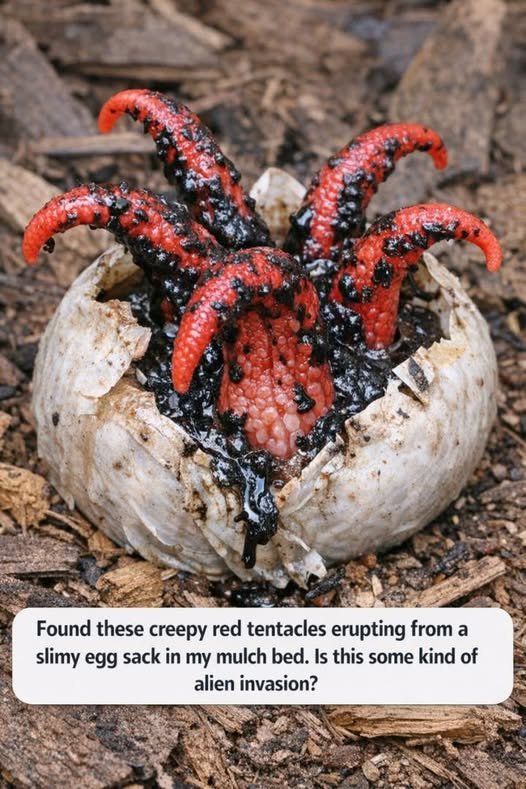
Imagine stepping outside to tend to your garden, only to discover a bizarre, alien-like structure nestled among your mulch. Red tentacles protrude ominously from a slimy, translucent egg sack, resembling a scene straight out of a science fiction movie. Your first instinct might be to wonder if these strange growths are part of an extraterrestrial invasion.
Before you call in the experts from NASA or the local news station, rest assured that these tentacle-like structures are not the result of alien activity. Instead, they are a natural, albeit unusual, occurrence. These growths are linked to a peculiar fungus that has gained notoriety for its shocking appearance and unsettling aroma.
1. The Shocking Sight: Red Tentacles In Your Mulch Bed
The sight of bright red tentacles emerging from your garden mulch is undeniably disturbing. These appendages can be anywhere from 4 to 8 inches long and are often covered in a slimy, gelatinous coating. They emerge from a white, egg-like sac that is typically about the size of a golf ball. The sac splits open to reveal the tentacles, which spread outwards in a star-like pattern.
For the uninitiated, this sight can be quite alarming, conjuring images of otherworldly creatures. The juxtaposition of vibrant red against the earthy tones of mulch only heightens the visual impact, making it appear as though something is alive and growing right beneath your feet.
2. Meet the Culprit: The Bizarre Devil’s Fingers Fungus
The eerie spectacle in your garden is caused by a fungus known scientifically as Clathrus archeri, commonly referred to as Devil’s Fingers. This fungus belongs to the stinkhorn family, a group known for their unusual shapes and strong odors. Originally native to Australia and New Zealand, Devil’s Fingers has spread to various parts of the world, often appearing in gardens, parks, and forests.
Characterized by its bright red tentacles and repugnant smell, Devil’s Fingers is a saprobic fungus, meaning it feeds on decaying organic matter. This ecological role makes it a natural part of the decomposition process, although its appearance can be quite unsettling to those unaccustomed to it.
3. From Slimy Egg Sack To Tentacles: How This Fungus Emerges
The life cycle of Devil’s Fingers begins with the formation of the egg-like structure, scientifically known as a ‘peridium.’ This structure is filled with a gelatinous substance that protects the developing fungus. As the fungus matures, the peridium splits open, allowing the tentacle-like arms to emerge.
Each of these arms, or tentacles, is covered with a spore-laden slime known as ‘gleba.’ This slime not only gives the fungus its signature odor but also plays a crucial role in spore dispersal, attracting insects that help spread the spores to new locations.
4. Why Devil’s Fingers Look (And Smell) So Disturbingly Alien
The startling appearance of Devil’s Fingers is due in part to its unique color and structure. The vivid red hue of the tentacles is a result of pigments that help attract insects, which are crucial for the fungus’s reproductive process. The tentacles’ irregular, finger-like shape further enhances the fungus’s alien look.
Beyond its appearance, Devil’s Fingers is notorious for its foul stench, often compared to rotting meat. This odor is a deliberate evolutionary strategy to attract flies and other insects, which inadvertently aid in spore distribution by carrying them to new environments.
5. Is It Dangerous? Health Risks To People, Pets, And Plants
Despite its unsettling appearance and odor, Devil’s Fingers is not considered dangerous to humans, pets, or plants. The fungus is not toxic, although its pungent smell may deter any attempts to taste or touch it. In most cases, the presence of Devil’s Fingers is harmless and poses no threat to the garden ecosystem.
For pets, the primary concern would be the odor, which might attract curious dogs or cats. However, ingestion of the fungus is unlikely to cause harm, though it may lead to mild gastrointestinal upset in some animals.
6. How This Weird Fungus Ended Up In Your Yard
see continuation on next page
For Complete Cooking STEPS Please Head On Over To Next Page Or Open button (>)