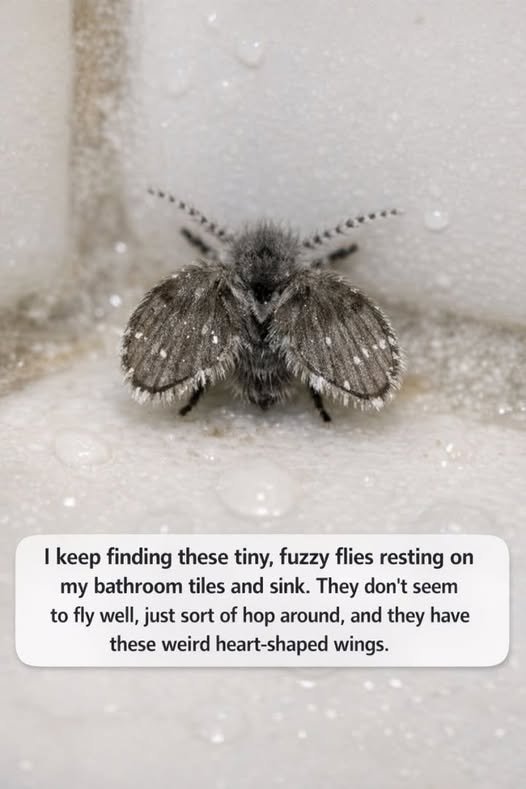
Have you ever noticed tiny, fuzzy flies resting on your bathroom tiles or sink, seemingly content to hop around rather than take to the air? These peculiar little creatures, with their distinctive heart-shaped wings, might seem like an oddity or an annoyance, but they are actually quite common in many households. Encountering these flies can be perplexing, especially when they appear in such specific areas of your home.
Understanding the nature of these flies and why they choose your bathroom as their preferred habitat is crucial in managing their presence. This article aims to shed light on these mysterious insects, providing detailed insights into what they are, why they are attracted to your bathroom, and how you can effectively manage and prevent an infestation. Whether you are simply curious or keen to tackle an ongoing issue, you’ll find the information you need right here.
1. What Those Tiny, Fuzzy Bathroom Flies Actually Are
The tiny, fuzzy flies you are finding in your bathroom are most likely drain flies, also known as sink flies or moth flies. These insects belong to the family Psychodidae and are often identified by their small size, typically about 1 to 5 millimeters in length, and their distinctive heart-shaped wings covered in fine hair, giving them a moth-like appearance. Despite their diminutive size, drain flies are quite hardy and can become a persistent nuisance if not addressed promptly.
Drain flies are not strong fliers. Instead, they tend to hop or make short flights, preferring to rest on surfaces where they can be easily spotted. They are commonly found near sources of moisture, such as sinks, showers, and drains, where they breed and lay eggs.
2. How To Tell Drain Flies From Fruit Flies, Fungus Gnats, And Mosquitoes
While drain flies can be easily mistaken for other small flying insects like fruit flies, fungus gnats, or mosquitoes, there are distinct characteristics that set them apart. Fruit flies, for example, are usually slightly larger and have a brownish coloration with distinctive red eyes. They are attracted to fermenting fruits and vegetables rather than drains.
Fungus gnats are often found near houseplants and are attracted to moist soil. They are typically smaller than drain flies and have slender, mosquito-like bodies. Mosquitoes, on the other hand, are larger, have long legs, and are often found near stagnant water. Unlike drain flies with their fuzzy appearance, mosquitoes have smooth bodies and are more agile flyers.
3. Why Drain Flies Love Your Bathroom Tiles, Sink, And Shower
Drain flies thrive in damp environments where there is an abundance of organic material on which they can feed. Your bathroom, with its combination of moisture, warmth, and organic debris from soap, hair, and skin cells, provides an ideal breeding ground for these flies. The gelatinous film that forms inside pipes and drains is particularly attractive to them.
These flies are typically found in areas of the bathroom where there is standing water or moisture, such as around sinks, showers, and bathtubs. The tiles and grout in these areas can also retain moisture, creating a hospitable environment for drain flies to rest and breed.
4. The Life Cycle Of Drain Flies: From Hidden Eggs To Heart-Shaped Wings
The life cycle of a drain fly begins when a female lays her eggs in a moist location rich in organic material, such as the inside of a drain. A single female can lay up to 200 eggs, which hatch within 48 hours. The larvae, which are tiny and worm-like, feed on the organic matter in the drain for about 8 to 24 days before pupating.
After a pupation period lasting 1 to 2 days, adult drain flies emerge. These adults typically live for about 20 days, during which time they continue to breed and lay eggs if the environment remains suitable. Understanding this life cycle is key to effectively managing and eliminating an infestation.
5. Sneaky Places Drain Flies Breed (And Why You Keep Missing Them)
Drain flies often breed in places that are not immediately obvious. Apart from the usual suspects like bathroom and kitchen sinks, they can also breed in less noticeable locations such as floor drains, condensation pans under refrigerators, and even the overflow holes in sinks. These areas often go unnoticed during regular cleaning.
The gelatinous film inside pipes, known as biofilm, is an ideal breeding ground for drain flies. This film is formed by the accumulation of organic material, and its presence deep within pipes and drains makes it a perfect, hidden habitat for drain fly larvae.
6. Simple At-Home Tests To Find The Exact Source Of Your Infestation
see continuation on next page
For Complete Cooking STEPS Please Head On Over To Next Page Or Open button (>)