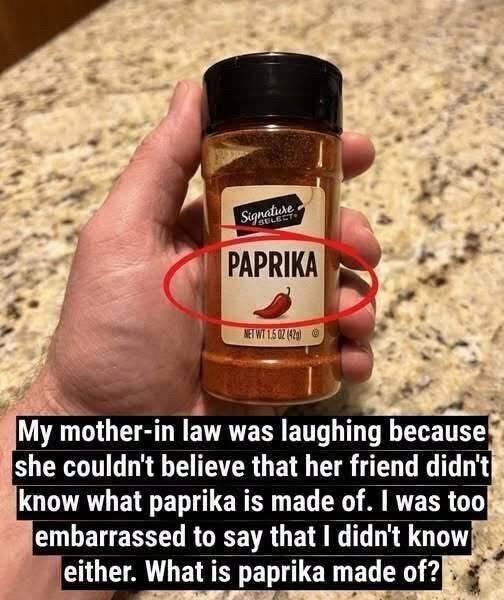
Paprika is one of those spices that seems so familiar that most people never stop to wonder where it actually comes from.
It sits quietly in kitchen cabinets, often in a small jar with a bright red powder inside. We sprinkle it over roasted potatoes, stir it into soups and stews, use it to season chicken, add it to sauces, and sometimes scatter it across a finished dish simply because it makes the plate look more colorful.
Yet ask a group of people what paprika is made from, and you may be surprised by the answers.
Some might assume it is a complicated blend of several spices. Others may think it is related to chili powder, while some may imagine that the bright red color comes from an artificial food coloring.
The reality is much simpler.
Paprika is made from dried, ground peppers.
That’s it.
More specifically, paprika is produced from varieties of the Capsicum annuum pepper family. Depending on the variety of pepper used and how it is processed, paprika can be sweet, mild, smoky, or noticeably hot.
That seemingly simple fact explains why paprika can taste so different from one jar to another.
So, What Exactly Is Paprika?
At its most basic, paprika is a powdered spice made by drying peppers and grinding them into a fine powder.
The peppers used for paprika are related to the peppers used to make many other familiar seasonings. The major difference is the variety of pepper and how it is processed.
The word “paprika” is closely associated with Central European cuisine, especially Hungarian cooking, but paprika has become an international pantry staple.
It can be found in dishes from Europe, North Africa, the Middle East, and the Americas.
The spice is particularly recognizable because of its brilliant red color.
But color doesn’t necessarily tell you how spicy paprika will be.
That’s one of the biggest misconceptions about the spice.
A deep-red paprika can be relatively mild, while another variety may have significantly more heat.
Paprika Isn’t Just One Type of Pepper
When people hear that paprika is made from peppers, they sometimes imagine one specific pepper growing on a plant and being turned into powder.
In reality, paprika can be made using different pepper varieties.
The characteristics of the final spice depend on several factors.
These include the type of pepper used, whether the pepper’s seeds and internal membranes are retained, how the peppers are dried, and how finely they are ground.
This is why two containers labeled “paprika” can produce noticeably different results in the kitchen.
One may be primarily sweet and fruity.
Another may be mild and earthy.
Another may have a smoky aroma.
And some may deliver a significant amount of heat.
The label matters.
Sweet Paprika
Sweet paprika is probably the variety most familiar to casual cooks.
Despite the word “sweet,” it doesn’t necessarily taste sugary like dessert.
Instead, “sweet” generally distinguishes it from hot paprika.
Sweet paprika tends to have a mild pepper flavor with subtle fruity or earthy notes.
It is often used when cooks want the color and flavor of paprika without adding substantial heat.
It works particularly well in dishes such as roasted vegetables, soups, sauces, rice dishes, eggs, chicken, and potatoes.
Because it is relatively mild, it can also be used generously.
A sprinkle over deviled eggs, for example, adds a distinctive red finish without dramatically changing the dish’s heat level.
Hot Paprika
Hot paprika is produced from peppers with more heat.
Depending on the variety and processing method, it can range from moderately spicy to quite fiery.
Hot paprika is useful when a recipe calls for both the distinctive flavor of paprika and a stronger kick.
It can be added to meat marinades, stews, bean dishes, sauces, and spicy vegetable recipes.
However, cooks should avoid assuming that every hot paprika has the same intensity.
As with many spices, products can vary considerably.
If you’re trying a new brand or variety, it’s smart to start with a small amount and adjust it later.
Smoked Paprika
see continuation on next page
For Complete Cooking STEPS Please Head On Over To Next Page Or Open button (>)