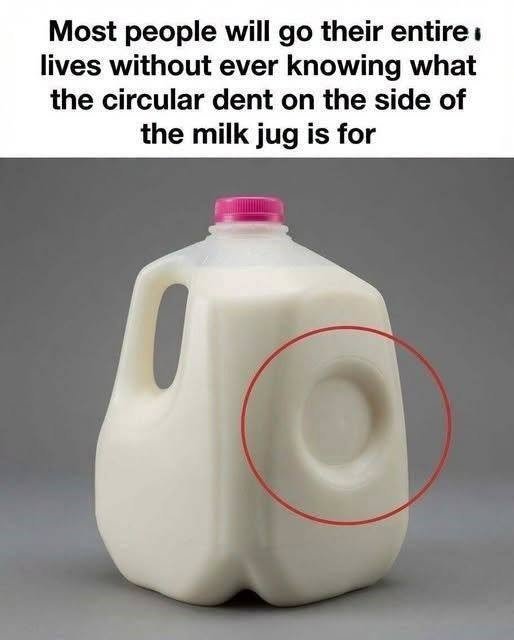
Have you ever picked up a plastic milk jug and noticed the strange circular indentation on one side?
It is one of those tiny details that most of us probably see hundreds of times without ever stopping to ask why it’s there.
You open the refrigerator.
You grab the milk.
You pour it into your cereal, coffee, tea, or a glass.
Then the jug goes back into the refrigerator.
The circular indentation is still there, quietly doing its job.
But what if that little dent isn’t random at all?
A viral image showing the side of a plastic milk jug has caused many people to take a second look at something they have probably been ignoring for years. The picture highlights the round indentation and asks a deceptively simple question:
What is that circular dent actually for?
The answer is more interesting than you might expect.
And once you understand why the jug is designed that way, you may never look at a gallon of milk the same way again.
The Mystery Hiding in Plain Sight
The circular indentation can look almost like someone pushed a finger into the side of the container while the plastic was still soft.
That’s partly because plastic milk jugs are manufactured through a molding process. Their unusual shapes aren’t accidental. Every curve, ridge, indentation, handle, and reinforced section can serve a purpose related to manufacturing, handling, storage, transportation, or the physical behavior of the container.
The circular feature is generally part of the jug’s structural design.
In other words, it isn’t simply decoration.
And it isn’t necessarily a manufacturing mistake.
It helps the container perform better than a completely flat-sided jug would.
That’s important because a plastic milk container has to survive quite a journey before it reaches your refrigerator.
Think about everything that happens between the dairy facility and your kitchen.
The jug has to be filled.
It has to be sealed.
It has to be moved into cold storage.
It may be stacked with other containers.
It can be transported in refrigerated trucks.
It can be placed on shelves.
Customers pick it up, carry it through a store, put it into shopping carts, and take it home.
During all of those steps, the container is exposed to pressure and movement.
A completely flat plastic wall would not necessarily be the best way to handle those forces.
That’s where carefully designed contours come in.
It’s Part of the Jug’s Structure
One of the simplest ways to understand the indentation is to think about the structure of the container.
A large, thin plastic surface can flex relatively easily.
If you make changes to its shape—adding curves, ribs, grooves, or indentations—you can alter how that surface responds to pressure.
This is common in packaging and engineering.
You can see similar principles in many everyday objects.
Corrugated cardboard is stronger than a flat sheet in certain directions because of its shape.
The ridges on plastic bottles can provide stiffness.
Metal cans have curved surfaces that help them resist pressure.
Containers aren’t always made stronger by simply adding more material.
Sometimes shape does the work.
The circular indentation on a milk jug is part of that idea.
Rather than being a meaningless dent, it’s incorporated into the molded shape of the container.
Why Doesn’t the Jug Just Have Flat Sides?
At first glance, a flat-sided container might seem simpler.
Why not just make a big rectangular plastic bottle with four flat walls?
Because those walls would be more flexible.
Imagine pressing your hand against a large, thin sheet of plastic.
It bends.
Now imagine that same material formed into a more complicated shape containing curves and recessed sections.
Its behavior changes.
The geometry gives the material additional rigidity.
Manufacturers have to balance several competing concerns when designing packaging.
The container needs to be strong enough for its intended use.
It needs to use an appropriate amount of plastic.
It needs to be easy to manufacture.
It needs to be stackable and transportable.
It needs to be comfortable enough for consumers to handle.
And it needs to fit efficiently into refrigerators and store displays.
That little circular feature is one piece of a much larger design.
The Jug Has to Handle Pressure
see continuation on next page
For Complete Cooking STEPS Please Head On Over To Next Page Or Open button (>)